Topic: 2025 Year-End and Updates for 2026
Speaker: Sally Hilton, PayrollOrg
Date: Thursday, December 11
Time: 5:00 pm Networking
5:30 pm Dinner
6:00 pm Speaker
Location: Kinzler Corporation, 700 SE Oralabor Rd, Ankeny, IA
November 2025 Newsletter 
Our Mission
The PayrollOrg of Greater Iowa is dedicated to providing information and education, support and networking opportunities to professionals involved in all aspects of payroll through our meetings, our newsletters, and our website. The Chapter strives to be a respected, essential and effective partner in the business community and to provide support to PayrollOrg.
Letter from the President
Hello PAYO-IA Members!
I hope this newsletter finds you well amidst preparing for year-end processing in the coming weeks! Speaking of year-end, save the date for December 11 from 5 - 7:30 pm as we have Sally Hilton (PayrollOrg) join us to speak about 2025 year-end and updates for 2026!
It was so great to see those of you in-person that were able to join us for the 2025 Statewide Payroll Conference. We hope we hit a grand slam with the event and continue to see increased participation at future events.
We recently held our Chapter Board elections and would like to welcome Angela Alsum back as our Newsletter Chair, while also thanking Gabby Uden for her time and efforts as she departs from the Board. I'm also honored to say that I am your new Chapter President! I have learned so much over the years from Former President, Tori Worley, and am excited to see what new heights we can take our chapter to!
Be on the lookout for links to our new social media platforms that are in development for PayrollOrg of Greater Iowa! These pages will be an amazing opportunity to network, ask questions, and get valuable updates from the chapter.
Wishing you all a bountiful holiday season!
Samantha Skogerboe, CPP
President, PayrollOrg of Greater Iowa
Statewide Conference
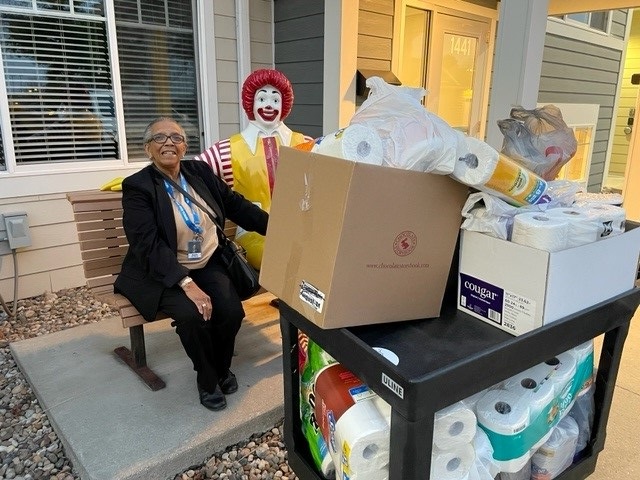
Thank You for Making a Difference!
As part of our National Payroll Week celebration, we hosted a paper towel and toilet paper drive on September 11 and 12, 2025—and wow, did our chapter show up!
A heartfelt thank you to everyone who donated. Your generosity helped support the Des Moines area Ronald MacDonald houses, and it truly reflects the spirit of giving that defines our payroll community.
Whether you brought a single roll or a whole case, your contribution mattered. Together, we proved that even the simplest items can make a big impact.
Let’s keep the momentum going and continue to find ways to give back.
Ronald says, “Payroll Rocks!”
—Gayla Nesbitt
NPW / Community Development Chair
PAYO-IA Chapter News
November Meeting
Date: Thursday, November 20, 2025
Time: 12:00 - 1:30 pm
Topic: Payroll Impact: One Big Beautiful Bill Act
Speaker: Pete Meza Lopez, CPP - Driscolls, Inc.
This session explores how the “One Big Beautiful Bill Act” impacts payroll operations. Key provisions include no tax on tips, no tax on overtime, and extensions of the Tax Cuts and Jobs Act (TCJA). Together, we’ll discuss real-world implications for payroll professionals and share insights on how to navigate these changes through year end.
Zoom link will be emailed to registered attendees the morning of November 20.
SAVE THE DATE
December Meeting
2025 Year-End and Updates for 2026
December 11, 2025
5:00 PM CST - 7:30 PM CST
Government Liaison Corner
IDR Issues New Income Withholding Tax Tables for 2026
The Iowa Department of Revenue is issuing updated income tax withholding formulas and tables for 2026. The Department updates withholding formulas and tables when necessary to account for inflation and for changes in individual income tax liability resulting from changes in Iowa law.
New for 2026
The Iowa withholding formula and the IA W-4 have been revised for tax year 2026 to accommodate changes to individual income tax required under the federal law known as the One Big Beautiful Bill Act, which was enacted on July 4, 2025.
The Iowa Code is automatically conformed to the Internal Revenue Code of the United States for tax purposes. This means that, with certain important exceptions, Iowa law emulates the tax law changes made at the federal level. The federal tax law changes enacted in 2025 generally decreased individual income tax liability beginning in 2026. The 2026 Iowa withholding tables accommodate this reduction.
Employers can view the Iowa 2026 withholding formulas and tables online.
Questions
Employers can contact the Department at 515-281-3114 or 800-367-3388.
2026 OASDI tax and earnings base increases to $184,500; COLA is 2.8%
Social Security beneficiaries will see an increase in their monthly checks in 2026 of 2.8%. This cost-of-living adjustment, or COLA, will produce an estimated average monthly benefit of $2,071 for all retired workers in 2026, $56 a month more than in 2025. The COLA increase will be applied to this coming year's benefits, beginning with benefits for December 2025, which are payable in January 2026.
The amount of earnings subject to taxation under FICA and SECA, the "wage base," is also going up in 2026. The 2026 wage base of $184,500 is $8,400 higher than the 2025 amount of $176,100.
Social Security Administration press release, October 24, 2025.
IRS releases 2026 inflation-adjusted tax tables, standard deduction, and other amounts
The IRS has released the annual inflation adjustments for 2026 for the income tax rate tables, plus more than 60 other tax provisions. The IRS makes these cost-of-living adjustments (COLAs) each year to reflect inflation.
The IRS has modified certain sections to reflect the amendments to the Internal Revenue Code by the One, Big, Beautiful Bill Act, Pub. L. 119-21, 139 Stat. 72 (2025), and has set forth inflation-adjusted items for various Code provisions.
2026 Income Tax Brackets
For 2026, the highest income tax bracket of 37 percent applies when taxable income hits:
- $768,700 for married individuals filing jointly and surviving spouses,
- $640,600 for single individuals and heads of households,
- $384,350 for married individuals filing separately, and
- $16,000 for estates and trusts.
2026 Standard Deduction
The standard deduction for 2026 is:
- $32,200 for married individuals filing jointly and surviving spouses,
- $24,150 for heads of households, and
- $16,100 for single individuals and married individuals filing separately.
The standard deduction for a dependent is limited to the greater of:
- $1,350 or
- the sum of $450, plus the dependent’s earned income.
Individuals who are blind or at least 65 years old get an additional standard deduction of:
- $1,650 for married taxpayers and surviving spouses, or
- $2,050 for other taxpayers.
Estate and gift tax adjustments for 2026
The following inflation adjustments apply to federal estate and gift taxes in 2026:
- the gift tax exclusion is $19,000 per donee, or $194,000 for gifts to spouses who are not U.S. citizens;
- the federal estate tax exclusion is $15,000,000; and
- the maximum reduction for real property under the special valuation method is $1,460,000.
2026 inflation adjustments for other tax items
The IRS also provided inflation-adjusted amounts for the:
- adoption credit,
- qualified transportation fringe benefit,
- health flexible spending cafeteria plans,
- various penalties, including the failure to file or furnish a correct information return, and
- many other provisions.
Effective date of 2026 adjustments
These inflation adjustments generally apply to tax years beginning in 2026, so they affect most returns that will be filed in 2027. However, some specified figures apply to transactions or events in calendar year 2026.
Rev. Proc. 2025-32, I.R.B. 2025-44, October 27, 2025.
Federal Agencies Provide Updates Amid Government Shutdown
Some federal agencies have provided updates and shared contingency plans as the government shutdown continues, including:
Bureau of Labor Statistics (BLS) – Due to limited employees, BLS delayed the release of the September Consumer Price Index (CPI). This is important as the 2026 social security wage base is based on the September CPI, which will now be released on October 24.
Social Security Administration (SSA) – Should announce the 2026 social security wage base on October 24; PayrollOrg members will receive a Compliance Update with this information. Released its Agency Shutdown Contingency Plan.
U.S. Department of Labor – Released its plan for the Continuation of L Limited Activities During a Lapse in Appropriations.
IRS – Released its Lapsed Appropriations Contingency Plan.
The IRS continues some operations, including releasing the cost-of-living-adjustments for 2026 that reflect increases in excludable transportation fringes, the flexible spending arrangement deferral limit, and other changes.
The IRS reminded taxpayers that the government shutdown does not affect tax filing and payment responsibilities.
IR-2025-92: Treasury, IRS issue guidance listing occupations where workers customarily and regularly receive tips under the One, Big, Beautiful Bill
Additional information on ‘no tax on tips’ came out late last week. It identifies the official occupations that customarily and regularly receive tips. It also defines “qualified tips” eligible taxpayers may claim as a deduction.
Question: The popular question regarding service charges has been answered.
Answer: It explains the automatic (mandatory) service charge imposed by restaurants for large parties does not qualify.
Below are also some social media images and language you can use in your communications.



Take a look at the #IRS and @USTreasury new guidance on the One, Big, Beautiful Bill’s “no tax on tips” provision: https://ow.ly/u3N550WZzVx
The #IRS and @USTreasury have issued guidance on “qualified tips” eligible taxpayers may claim as a deduction under the One, Big, Beautiful Bill. See: https://ow.ly/u3N550WZzVx
New guidance offers a definition of qualified and not qualified tips that may be claimed as a deduction under the One, Big, Beautiful Bill’s “no tax on tips” provision: https://ow.ly/u3N550WZzVx
Can you claim a deduction under the One, Big, Beautiful Bill’s “no tax on tips” provision? Check out the #IRS site and see the nearly 70 occupations of tipped workers who may qualify: https://ow.ly/u3N550WZzVx
SECURE 2.0 Update: Final Roth Catch-Up Regulations
SECURE 2.0 requires that catch-up contributions made by employees with FICA wages of more than $145,000, indexed and based on prior calendar year wages, be designated as Roth contributions. Final regulations regarding this new mandate were released in September and make clear that employers have several decisions to make in implementing this new requirement. The mandate is still effective January 1, 2026. Amendments to plan documents are not required until December 31, 2026, or December 31, 2029 for governmental plans.
To Deem or Not to Deem
The final regulations provide different approaches for implementing the Roth catch-up mandate. Under the deemed approach, all elections by catch-up-eligible employees subject to the mandate shift to Roth when contributions hit the Code Section 401(a)(30) (i.e., $23,500 in 2025) limit. The regulations permit the shift to occur when all an employee's contributions reach the limit or when the limit is reached looking only at pre-tax contributions. Employers must provide employees an opportunity to make a different election. An employer's choice to use the deemed approach must be stated in the plan document and should be included in participant communications.
Alternatively, employers may use the "affirmative election" approach, under which applicable employees must actively elect Roth treatment for their catch-up contributions. If an employee does not make an election, they may not make catch-up contributions until a Roth catch-up election is made.
Many employers will find that the deemed approach works best for their employees and their plan. The deemed approach is the least disruptive to employees, and it affords employers greater flexibility in correcting operational mistakes related to the Roth catch-up mandate.
Applicability to Plans Without a Roth Program, 403(b)/457(b) Special Catch-Ups, and Dual-Qualified Plans
If a plan does not have a qualified Roth contribution program, the final regulations do not require plan sponsors to adopt such a program. However, participants subject to the Roth catch-up mandate may not make catch-up contributions in plans without a designated Roth contribution program.
The final regulations provide additional information on how the mandate interacts with 403(b) plans, 457(b) governmental plans, and plans qualified under both 401(a) and the Puerto Rico Code (dual-qualified plans). In a 403(b) plan, if an employee is eligible to make special 403(b) catch-up contributions and is also subject to the Roth catch-up mandate, then only amounts exceeding the special catch-up limit are subject to the mandate. A similar rule applies for governmental 457(b) plans and the special catch-up limit under those plans.
Lastly, transition relief was provided for dual-qualified plans and multiemployer plans. Puerto Rico participants are not subject to the mandate until the first taxable year that the Puerto Rico Code is amended to provide for designated Roth contributions. Similarly, multiemployer plans are deemed to satisfy the mandate until the first taxable year following the date on which the parties' collective bargaining agreement in effect on November 17, 2025 terminates.
Employer Aggregation: Whose Wages Count for the Threshold?
Generally, when employers are related (for example, because they are under common control or part of an affiliated service group), they are treated as a single employer for most retirement plan purposes. However, for the purpose of determining whether an employee is subject to the Roth catch-up mandate, the proposed regulations provide that wages are not aggregated among related employers. The final regulations retain this as the default rule but permit employers to choose to aggregate wages with related employers in certain instances.
Action Items
We anticipate that recordkeepers and payroll providers have or will soon provide an explanation of their process for implementing the Roth catch-up mandate. Many are distributing election forms requesting the plan sponsor's election with respect to the deemed or affirmative election approach. We recommend:
- Electing to use the deemed approach when implementing the Roth catch-up mandate. Regardless of the approach used, keep a record of your decisions as it will be needed for your plan document amendment in 2026.
- If the deemed approach is used, discussing with your recordkeeper and payroll provider whether it will apply when an employee's contributions reach the 401(a)(30) limit, or only when pre-tax contributions reach the limit.
- Determining which tasks will be performed by the plan sponsor, the recordkeeper, payroll provider or other service providers when implementing the Roth catch-up mandate, including:
- Identifying which employees are subject to the Roth catch-up mandate.
- Identifying the first payroll period when the mandate applies and how this information will be communicated so that a change is made in payroll.
- Receiving affirmative or opt-out elections from impacted participants and how this information will be communicated so that a change is made in payroll.
The content of this article is intended to provide a general guide to the subject matter. Specialist advice should be sought about your specific circumstances.
IRS issues 2026 adjusted limits for various benefits
In Rev. Proc. 2025-32, the IRS provides a variety of inflation-adjusted figures for 2026, including figures for cafeteria plans, medical savings accounts (MSAs), transportation fringe benefits, and adoption assistance.
Cafeteria plans. For taxable years beginning in 2026, the dollar limitation for employee salary reductions for contributions to health flexible spending arrangements rises to $3,400, increasing from $3,300 in tax year 2025. For cafeteria plans that permit the carryover of unused amounts, the maximum carryover amount rises to $680, increasing from $660 in tax year 2025.
Qualified transportation fringe benefit. For tax year 2026, the monthly limitation for the qualified transportation fringe benefit and the monthly limitation for qualified parking rises to $340, increasing from $325 in tax year 2025.
QSEHRA. For taxable years beginning in 2026, to qualify as a qualified small employer health reimbursement arrangement, the arrangement must provide that the total amount of payments and reimbursements for any year cannot exceed $6,450 ($13,100 for family coverage).
Medical savings accounts. For tax year 2026, for participants who have self-only coverage, the plan must have an annual deductible that is not less than $2,900 (a $50 increase from the previous tax year), but not more than $4,400 (an increase of $100 from the previous tax year). The maximum out-of-pocket expense amount rises to $5,850, increasing from $5,700 in tax year 2025.
For family coverage in tax year 2026, the annual deductible is not less than $5,850, increasing from $5,700 in tax year 2025; however, the deductible cannot be more than $8,750, an increase of $200 versus the limit for tax year 2025. For family coverage, the out-of-pocket expense limit is $10,700 for tax year 2026, rising from $10,500 in tax year 2025.
Adoption assistance. For tax year 2026, the maximum credit allowed for an adoption of a child with special needs is the amount of qualified adoption expenses up to $17,670, increased from $17,280 for tax year 2025. The excludable amount begins to phase out at $265,080 and is completely phased out at $305,080.
Employer-provided childcare tax credit. For tax year 2026, the One Big Beautiful Bill Act significantly enhances an important credit for employers; it increases the maximum amount of employer-provided childcare tax credit from $150,000 to $500,000 ($600,000 if the employer is an eligible small business).
SOURCE: IRS Rev. Proc. 2025-32, IR-2025-102, Oct. 9, 2025
Board Members
President: Samantha Skogerboe, CPP
Email: [email protected]
Vice President: Tori Worley, CPP
Email: [email protected]
Secretary: Carol Fisher
Email: [email protected]
Treasurer: Barbara Craig
Email: [email protected]
Membership: Deb Cole, CPP
Email: [email protected]
Government Liaison: Dave Moll
Email: [email protected]
Education Chair: Holly Atkin
Email: [email protected]
National Payroll Week/Community Development: Gayla Nesbitt
Email: [email protected]
Nominations/Newsletter: Angela Alsum, CPP
Email: [email protected]
